
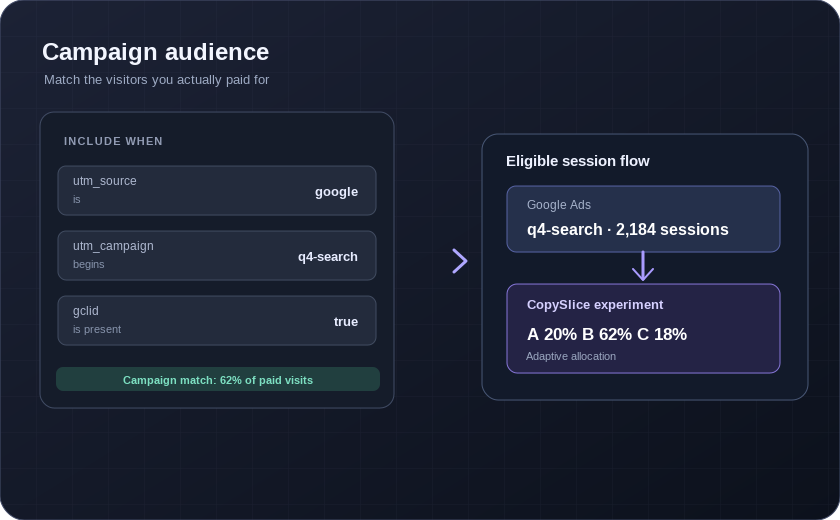
Traditional A/B testing and multi-armed bandits answer related but different questions. Both can compare variations of a landing page. The difference is what they do with traffic while the experiment runs.
A/B testing: keep allocation predictable.
A conventional fixed-split A/B test allocates visitors to variations at predefined rates, often 50/50 for two options. With a suitable analysis plan, that stable assignment makes it easier to estimate a treatment effect and communicate uncertainty.
Its trade-off is that the experiment keeps assigning visitors to alternatives even after early observations suggest one might be worse. Early impressions can be wrong, though, so stable allocation is not automatically wasteful.
Multi-armed bandits: adapt allocation during the test.
A bandit algorithm periodically looks at observed outcomes and changes assignment probabilities. Thompson Sampling, for example, samples plausible conversion rates from a model for each variation and puts more traffic behind the options that currently look promising.
Where paid traffic changes the equation.
If you are paying for each landing-page visit, you may care about performance during the experiment as much as identifying a winner afterward. A bandit can be attractive when a campaign runs continuously, variants are approved in advance, and the objective is to capture leads while learning.
Short campaigns, sparse conversions, and dramatic shifts in campaign audiences can make adaptation unreliable. In these cases, a fixed split or an extended balanced phase may be a better choice.
The delayed-conversion problem.
A B2B prospect may return days later and book a meeting. If the optimizer instantly treats every visitor who has not converted as a failure, it will favor variants that generate quicker leads, not necessarily the most valuable leads. A careful system distinguishes the optimization reward window from full-window attribution reporting.
Why a holdout matters.
When assignment probabilities change over time, raw variant conversion rates are not straightforward equivalents of fixed-split test estimates. A randomized comparison group and assignment-probability logging can provide context, though the analysis still needs to respect adaptive allocation.
Which should you use?
- Choose a conventional A/B test when clean treatment-effect estimation and a fixed comparison are the main goals.
- Consider a guarded bandit when there is sufficient recurring traffic, the objective includes performance while learning, and delayed outcomes are handled consistently.
- Do not force either when the campaign will end before enough conversions can mature.
CopySlice is designed for the second case: approved headline and CTA variants on existing paid landing pages, with campaign scoping and safeguards rather than unbounded optimization.
Make your next landing-page experiment count.
Estimate your testing runway before you launch, or apply to work with CopySlice on a paid-campaign pilot.