Choose your message
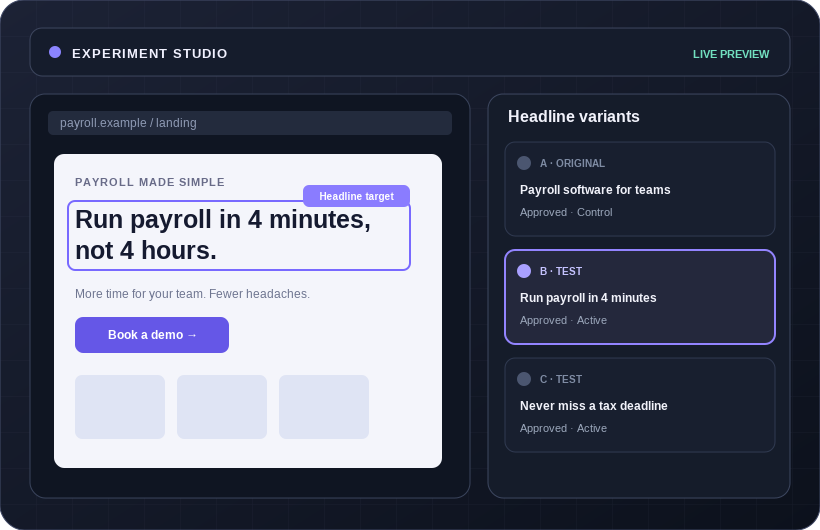
Select a headline, subheadline, or CTA on an existing page. Write alternatives or use AI to draft them, then approve each option before launch.

Home / Product
THE PRODUCT
CopySlice gives performance teams a controlled way to test messaging on paid landing pages, learn from conversions, and shift traffic toward promising variants. Your existing page builder stays in place.
THE WORKFLOW
Run repeatable copy experiments without publishing a different landing page for each headline.
Select a headline, subheadline, or CTA on an existing page. Write alternatives or use AI to draft them, then approve each option before launch.
Use campaign parameters and URL conditions to decide precisely which eligible visitors enter the experiment.
Choose the conversion you care about, from a form completion to a qualified demo booking, with the right attribution window.
Start with balanced traffic. Once enough observations mature, guarded adaptive allocation can favor better-performing variants.
Review variant performance, allocation history, and full attribution reporting, with a randomized comparison holdout.
AUDIENCE TARGETING
A branded search click and a competitor-keyword click are not the same audience. CopySlice lets your experiment respect that.
Match UTM source, UTM campaign, page URL, and supported click identifiers. Keep organic traffic outside paid tests, or explicitly group related campaigns when their intent is comparable.
utm_source = googleutm_campaign starts_with nonbrand_page_path = /demoTHEN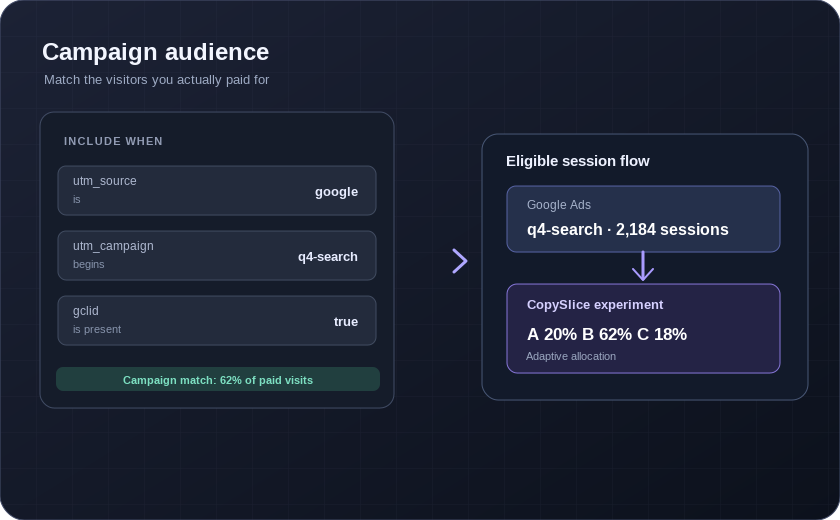
LEAD ATTRIBUTION
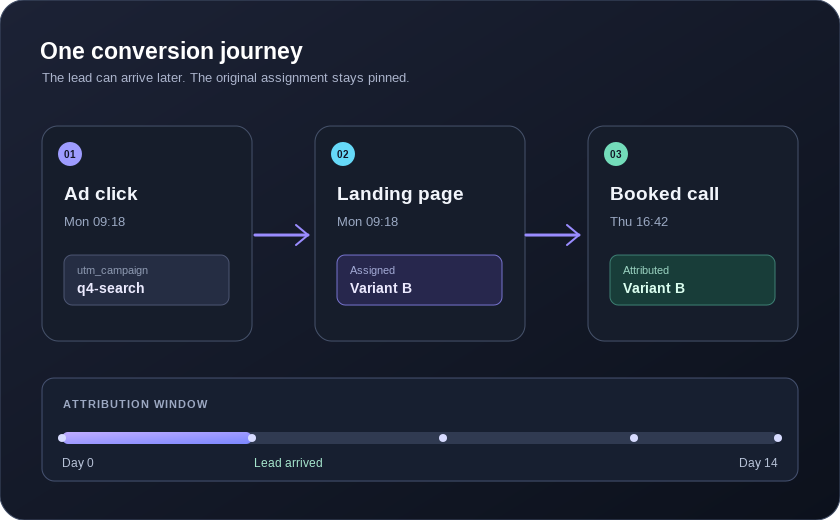
Lead generation rarely ends on the first pageview. CopySlice is designed to connect delayed outcomes with the variant a visitor actually saw.
Keep the original campaign and variant assignment available for the configured reporting window, with duplicate-event protection and separate policies for optimization and full attribution reporting.
When the optimization goal is a fast lead, it can use a shorter, explicitly chosen reward horizon while the complete 14-day attribution window remains visible in reporting.
GUARDRAILS
Adaptive allocation does not eliminate uncertainty. It needs deliberate limits, especially when conversions are sparse.
Keep initial traffic evenly distributed until the experiment has enough matured observations to start adapting.
Continue showing alternative variants so the optimizer has an opportunity to detect a change in performance.
Update traffic allocation on a schedule with limits on how quickly the distribution can change.
Retain a randomized comparison group to provide context for performance estimates.
Restore original content on failed configuration and stop allocation when critical instrumentation health checks fail.
Founding pilot
We are onboarding a limited number of PPC teams to shape the first release. Tell us your page, goal, and traffic volume.