
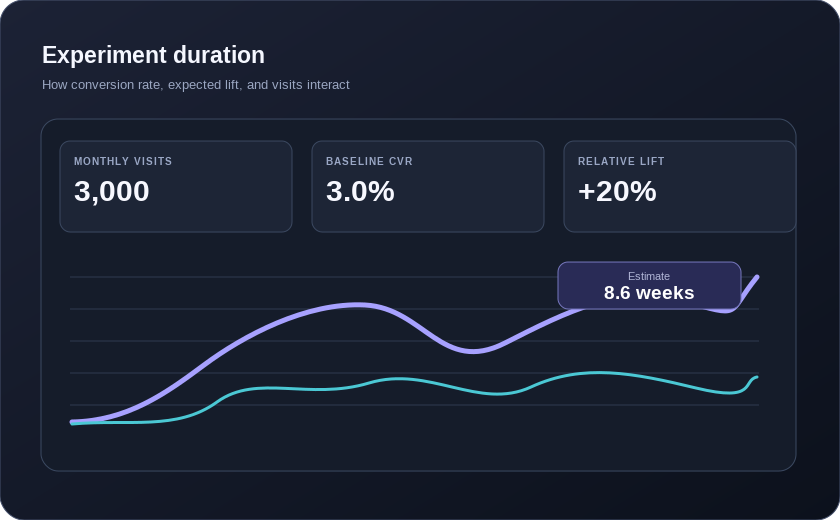
A landing-page test needs more than two headlines. It needs enough eligible visitors and conversions to tell a useful story. The amount depends on your existing conversion rate, the smallest improvement you care about, and the type of experiment.
Start with the conversion you actually value.
A button click may happen quickly but may not represent a qualified lead. A booked demo can take days to arrive, while a later-stage opportunity can take weeks. Write down the primary goal before estimating test duration.
Think in absolute conversion-rate changes.
If a page converts 3% of its paid visitors, a 20% relative improvement means a conversion rate of 3.6%, not 23%. Detecting that 0.6 percentage-point difference generally requires far more observations than a dramatic change from 3% to 6%.
Sessions alone are not enough.
A page with 3,000 paid visits per month at 3% CVR receives around 90 conversions per month. If the page runs three variants, those events are spread across several groups. A low-volume campaign can take longer than its media flight to accumulate useful evidence.
Conversion delays extend the learning timeline.
With a 14-day outcome evaluation horizon, an assignment made yesterday has not completed its observation window today. Counting its missing conversion immediately as a failure would bias an optimization model toward faster-converting messages.
Estimate a traditional A/B test first.
Use the CopySlice duration calculator to explore a conventional two-proportion sample-size estimate. It is a planning benchmark, not a promise that a bandit will find a winner by that date.
What to do if your page is too small.
- Run fewer variants and focus on a meaningful message difference.
- Consolidate genuinely comparable campaigns on the same landing page when doing so preserves a valid audience.
- Choose a conversion goal that has enough volume and still reflects business value.
- Allow more calendar time, including the conversion maturation window.
- Decide not to run the experiment when the available evidence cannot support the decision.
For paid traffic, avoiding an inconclusive experiment can be as valuable as launching one.
Make your next landing-page experiment count.
Estimate your testing runway before you launch, or apply to work with CopySlice on a paid-campaign pilot.